
 EN
EN AR
AR HI
HI ES
ES FR
FR DE
DE

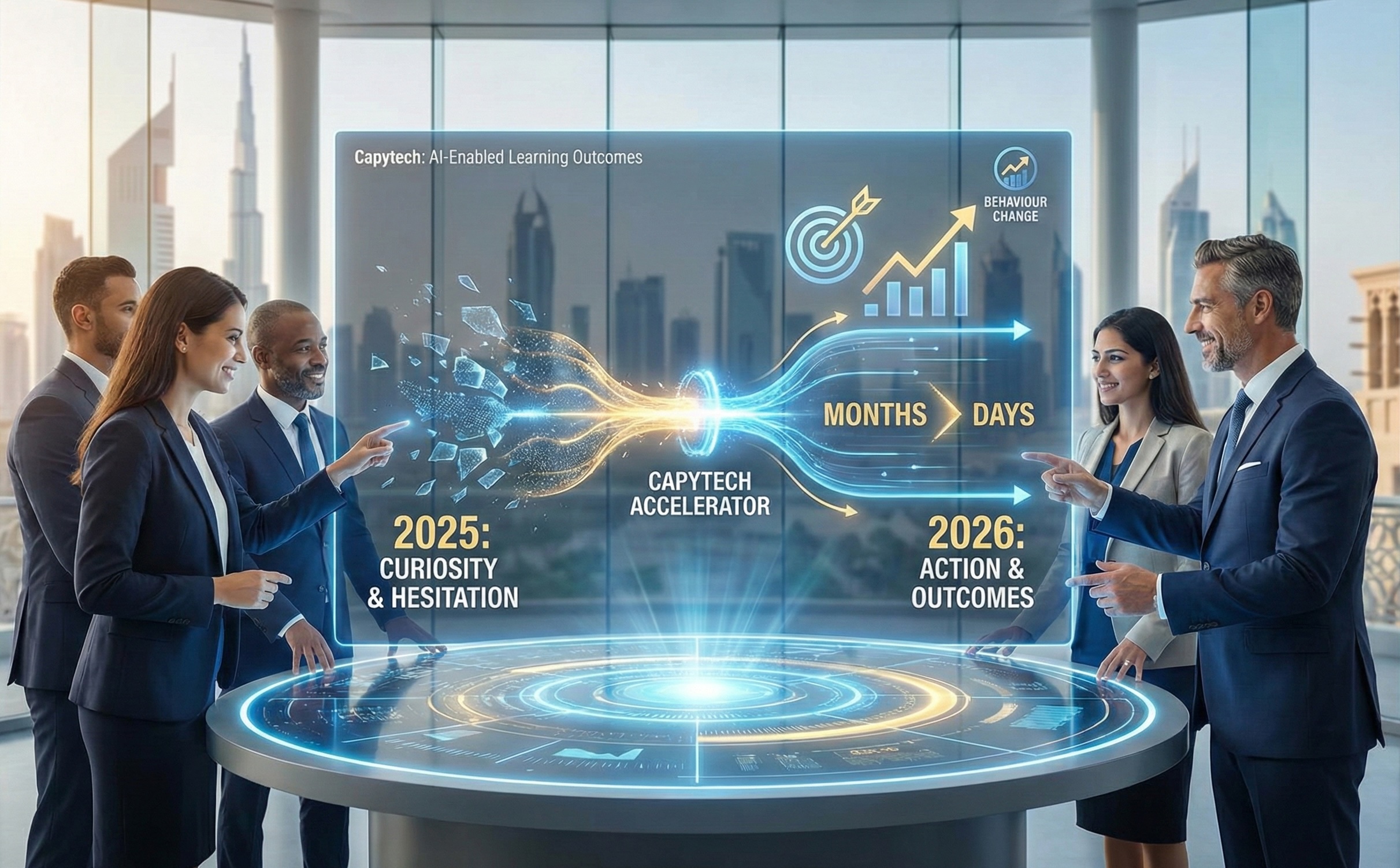
From AI Curiosity to AI Action
What 2025 taught Damian Hehir of Capytech about the gap between interest and implementation
2025 was a year of paradox for corporate learning.
At the individual level, AI adoption was everywhere. L&D professionals experimented with generative tools. Instructional designers accelerated their workflows. Curiosity about AI's potential ran high across the region. Yet at the strategic level, many large organisations remained hesitant. Some were actively resistant.
We saw global corporates blocking AI tools entirely. Others permitted limited experimentation but struggled to move beyond pilots into meaningful integration. The gap between individual enthusiasm and organisational readiness was striking.
After 11 years building custom learning solutions across the Middle East, here's what I observed. And what I believe is about to change.
The 2025 Reality: Curiosity Without Commitment
Most organisations approached AI cautiously. Understandably so. Questions around data security, content accuracy, and governance created genuine barriers. Many L&D teams found themselves caught between personal productivity gains from AI tools and corporate policies that hadn't caught up.
The result? A fragmented landscape where innovation happened in pockets rather than at scale.
What's Shifting in 2026
I'm convinced 2026 marks the inflection point. The organisations that spent 2025 watching from the sidelines are now facing competitive pressure to act. AI literacy is no longer optional for L&D professionals. It's becoming a baseline expectation.
More importantly, the conversation is maturing. It's less about "Should we use AI?" and more about "How do we use AI responsibly to achieve better outcomes, faster?"
Our Response: The Capytech Accelerator
At Capytech, we've been integrating AI into our content development and design processes for some time. But this year, we launched the Capytech Accelerator. It's a programme designed to put AI capabilities front and centre, enabling organisations to respond to learning needs with unprecedented speed.
The goal isn't AI for its own sake. It's about outcomes: reducing development timelines dramatically while maintaining the quality and cultural relevance our clients expect. When a compliance requirement changes or a new product launch, organisations shouldn't wait months for supporting training materials. They need to respond in days.
The Outcome Imperative
This brings me to what I believe will define successful L&D functions in 2026: ruthless focus on outcomes.
Technology, AI included, is only valuable if it delivers measurable results. The most effective organisations will be those that combine AI-enabled speed with clear metrics: behaviour change, performance improvement, business impact.
The tools have arrived. The question now is whether we'll use them to transform learning outcomes or simply do the same things faster.
Here's the thing. I'm not the first to say this, but if all AI progress stopped today, we'd still be discovering workplace benefits for probably a decade. Of course, progress won't stop. Given how far we've come in the last year alone, trying to predict where we'll be is impossible. That's exactly why being AI curious isn't optional anymore. It needs to be official policy.
I'm optimistic. The conversations I'm having with L&D leaders across the region suggest appetite for genuine transformation. Not just incremental improvement.
Damian Co-founder & CEO, Capytech UAE
Related Posts

HR Leaders Conference Riyadh September 2024
Save The Date https://ksa.hrleadersconference.com/register-for-hrlc-riyadh/ HRLC Saudi Arabi...

Save The Date! The Third GCC Exhibition for Training & Education 2024
Let's Shape the Future of Education Together for 2024!✨ Don't Miss Out On&nbs...

Qatar SMART Education Conference 2025
About the Conference https://www.qatarsummits.com/copy-of-delegate-inquiry The Qatar SMART Edu...

Well Being at Work Middle East 2022
The 6th Wellbeing at Work Summit Middle East takes place 21-23 February 2022. The three-day festival...

Minister of Human Resources and Emiratisation meets Iranian Ambassador to UAE
His Excellency Dr. Abdulrahman Al Awar, Minister of Human Resources and Emiratisation, met with His ...

3rd People Development Summit February 2022
Join PDS for the People Development Summit at the Address Dubai Marina The London-based compa...

Be Part of The Conversation -Should Business be Inclusive?
London Business School would like to invite you to the latest online Think Ahead ...
.jpg)
Save the Date for The Future of Work Confluence 2025
Registration link: Future of Work Confluence - Home The Future of Work Confluence 2025 ...

Ashirvad Lobo Gold Winner at Learning Professional of the Year Awards 2022
The top organisations and outstanding individuals in learning gathered together in London to celebra...

HR Leaders Conference in Dubai in November
https://dubai.hrleadersconference.com/ Welcome to HR Lead...
