AI Will Build Your E-Learning in Minutes — But Can You Take It With You?
E-learning authoring in the age of AI: convenience, control, and the lock-in nobody warns you about
OPINION PIECE
Damian Hehir, Co-founder, Capytech
7/13/20265 min read
A couple of months ago I wrote here about what an AI-Native LMS actually does for L&D once you get past the buzzwords. This is the other side of that coin: not the platform your learners sit on, but the tools you use to build the content — and one question that too few teams ask before they’re in too deep.
We use AI every single day at Capytech — drafting text, generating content, producing images, and a great deal more. So I’m not here to talk anyone out of it. But a year or two ago, AI-assisted authoring was more of a novelty. You’d go into ChatGPT and have it write a few multiple-choice questions for you. Today a growing number of learning platforms let you generate a whole course inside the platform itself — upload a policy document, answer a few prompts, and you have a draft in minutes. That’s a real shift, and it comes with a trade-off worth understanding before you scale it.
The upside is real
Let me be fair to the technology first, because the benefits are genuine.
Speed. Fully immersive e-learning used to take days or weeks. You can now go from a policy document to a partially interactive module in minutes — at least to a useful first draft. That caveat matters, and I’ll come back to it.
A lower barrier to entry. Good authoring tools like the Articulate suite have a learning curve, especially once you’re into triggers and the more powerful features. AI-driven authoring is simpler. You lose some flexibility, but it opens the door to people who aren’t L&D professionals — the health and safety specialist, say — to put something together quickly.
Faster iteration and more consistency. New policy in, a few clicks, content updated. And because you’re running everything through the same tool, the tone, structure and format tend to be more consistent than when different stakeholders and vendors each build their own way. Honestly, most organisations we deal with don’t have a well-articulated standard for how their e-learning should look — so this can genuinely help.
The lock-in nobody warns you about
Here’s the part that gets missed. The faster and easier it is to build inside your platform, the more content you accumulate there — and the more you may never be able to take with you.
This isn’t new. Learning platforms have let you author content for years. But AI turns a trickle into a flood. Build enough of it natively, and you’re effectively locked in.
I’ve always advocated separating your learning platform from your learning generation. The honest downside is that natively built content can look more seamlessly integrated — shown inline, tighter to the system. But I’ll take that trade every time, for one reason: when you build inside a system, you often can’t get your content back out.
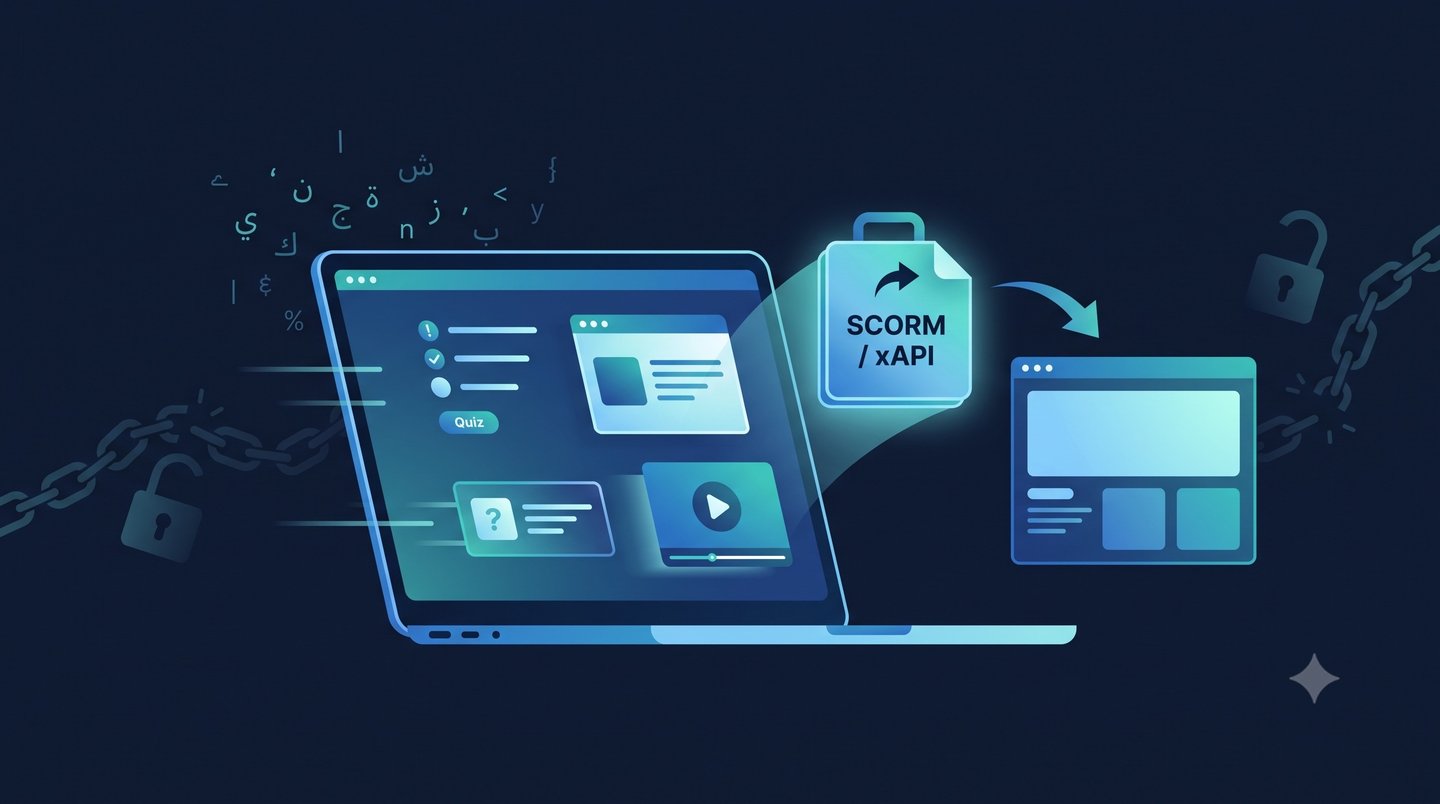
It happens again and again. A company decides not to renew a licence — a change of direction, a performance issue, whatever it is — and discovers that everything built on that platform is stranded. So the first thing to insist on is a real export function: SCORM or, ideally, xAPI. SCORM is still by far the most universally accepted format; xAPI is more capable but far less widely adopted. Ideally you want both.
Without that, switching platforms is far more painful than people realise — you’re rebuilding your entire library from scratch. When we build in Storyline or Rise, that content travels. You take the SCORM file, drop it onto any system you like — internal, blue-collar audience, external audience, as many as you want — and it usually just works.
Which leads to the question you should ask every vendor: who actually owns this content? You’ll almost certainly keep the IP. But do you really own it if you can’t get it out? If your only export is a PDF or a video, you’ve lost the interactivity, the tracking, the ability for learners to resume and report progress — everything SCORM gives you.
Speed is not a reason to skip QA
You can get to a draft very fast. For something low-stakes — a quick internal note, a short report — that’s usually fine. But for e-learning going to hundreds or thousands of learners, quality assurance is not optional. Three things in particular:
Factual accuracy. When we build with AI, we red-team the output against the original source material. AIs are improving all the time, but they still hallucinate, and a mixed-up figure in a compliance module is exactly the kind of error you can’t afford. We take that red-teaming seriously.
Instructional design. Converting a code of conduct into e-learning isn’t dropping each page onto a screen. You need objectives, a sensible structure, an assessment that actually assesses those objectives, all aligned to the goal of the programme. Some tools do this better than others — check it robustly. Content is not the same as learning.Text on a screen is easy; applying the science of learning so it’s engaging and memorable is the hard part, and it’s where AI still needs a human hand.
Accessibility and localisation. If you have accessibility standards, make sure the AI output still meets them. And localisation remains a genuine challenge — particularly right-to-left languages like Arabic, our second most common language and no small matter in this region. If you’re rolling out in multiple languages, that’s where QA matters most.
The rule of thumb: build in the platform what you’re happy to lose
That’s it, really. If content is transient — a small policy update, a bit of company news, fast-changing product information, low-stakes and non-regulatory — build it directly in your platform. It might change next month anyway. It’s semi-disposable.
But own what you can’t afford, or don’t want, to rebuild. Compliance and regulatory programmes that may be audited or inspected. Onboarding — often an organisation’s flagship learning and one of the first impressions a new joiner gets; we can spend months on these. Leadership content, which tends to be timeless. Anything you’ll maintain and reuse for years. Build that in something portable.
A short checklist before you commit
A few questions worth putting to any platform before you lean on its AI authoring:
• Export. Can you get a clean SCORM or xAPI file — and does it actually work? Sometimes the “SCORM” export is just images of your slides, with all the interactivity stripped out. Check the quality.
• Source files. Do you own an editable version? A SCORM file you can’t edit isn’t much use if your branding or content changes. We give clients the source files as well as the SCORM, so they’re never locked into us.
• Exit rights. What happens to your content if you cancel or switch? Does it age out? Get deleted?
• Data usage. How is your content used? Enterprise agreements with the major LLM providers guarantee your data won’t train their models. Do you have the same assurance for AI-generated content on your learning platform — especially if any of it is sensitive?
Where this leaves you
AI is brilliant. It’s a genuine accelerant across so many domains, and e-learning is firmly one of them — embrace it wherever it makes sense. But keep your content portable, own what matters, verify that assessments match objectives and content matches its source, red-team it, and stay accountable. That professional responsibility still sits with you, whether your learners are internal or external. AI can’t take it off your hands.
The best decisions here come from asking the right questions early — before you’ve got dozens of courses built and the switching cost becomes very real.
Damian Hehir is Co-founder of Capytech, an L&D solutions company headquartered in Dubai. Capytech holds the Dubai AI Seal and works with public and private sector clients across the GCC on e-learning, AI-native LMS deployments and bilingual content development.
Damian’s profile: linkedin.com/in/damianhehir
ME HR & Learning is THE leading online news and information platform for HR and L&D professionals in the Middle East.

© Copyright 2026 ME HR & Learning
The Platform
Learning & Resources
Professional Network
Location
Sharjah Media City, SHAMS, UAE