
 EN
EN AR
AR HI
HI ES
ES FR
FR DE
DE

A New Leadership Paradigm is Emerging
From Burnout to Balance: The Future of Regenerative Leadership
In today’s world of relentless change, complexity, and constant connectivity, leadership has too often been defined by endurance — how much pressure one can handle, how many hours one can sustain, how many targets one can achieve. Yet, the cost of this outdated paradigm is visible across industries: record levels of burnout, stress-related illnesses, and disengaged teams.
According to the World Health Organization, burnout is now recognized as an occupational phenomenon, costing the global economy an estimated $322 billion annually through absenteeism, presenteeism, and turnover.
In the UAE, the Cigna 360 Global Wellbeing Survey (2024) revealed that 98% of employees report feeling stressed, with over half citing work-related pressure as the main driver.
The antidote to this escalating crisis is not found in doing more, it’s found in balancing peak performance with quality recovery time, grounded presence, and optimal wellbeing and vitality.
From Performance to Regeneration
Over the last two decades, I’ve led 70+ expeditions across the globe, from the Arctic to the Antarctic, guiding leaders and teams to discover what nature has known all along: that regeneration is not optional; it’s essential for survival and growth. Whether climbing mountains, navigating deserts, exploring the polar regions, one principle holds true: nature thrives through cycles of energy, not endless exertion.
When I transitioned from leading expeditions to developing corporate and executive programs, I noticed the same truth echoed in boardrooms. Talented leaders were operating in “survival mode.” Many were running on adrenaline, caffeine, and willpower which is not sustainable.
That realization led me to pioneer The Regenerative Leadership Model, a nature-inspired framework designed to restore equilibrium between output and renewal, achievement and alignment, doing and being.
The Business Case for Regenerative Leadership
The ROI of regeneration is measurable. Research consistently shows that leaders who prioritize recovery, self-regulation, and optimal wellbeing perform better, inspire more, and stay longer.
• McKinsey (2023) found that high-performing executives who engage in intentional recovery practices report 41% higher creativity, 31% better decision-making, and 40% greater team engagement.
• The Harvard Business Review highlights that energy management (not time management is the true key to sustainable performance.
• Studies from Stanford University show that chronic stress reduces cognitive flexibility, empathy, and innovation the very traits needed for adaptive leadership.
In other words, regeneration is not a ‘nice to have ‘it’s a leadership imperative.
The Regenerative Leadership Model
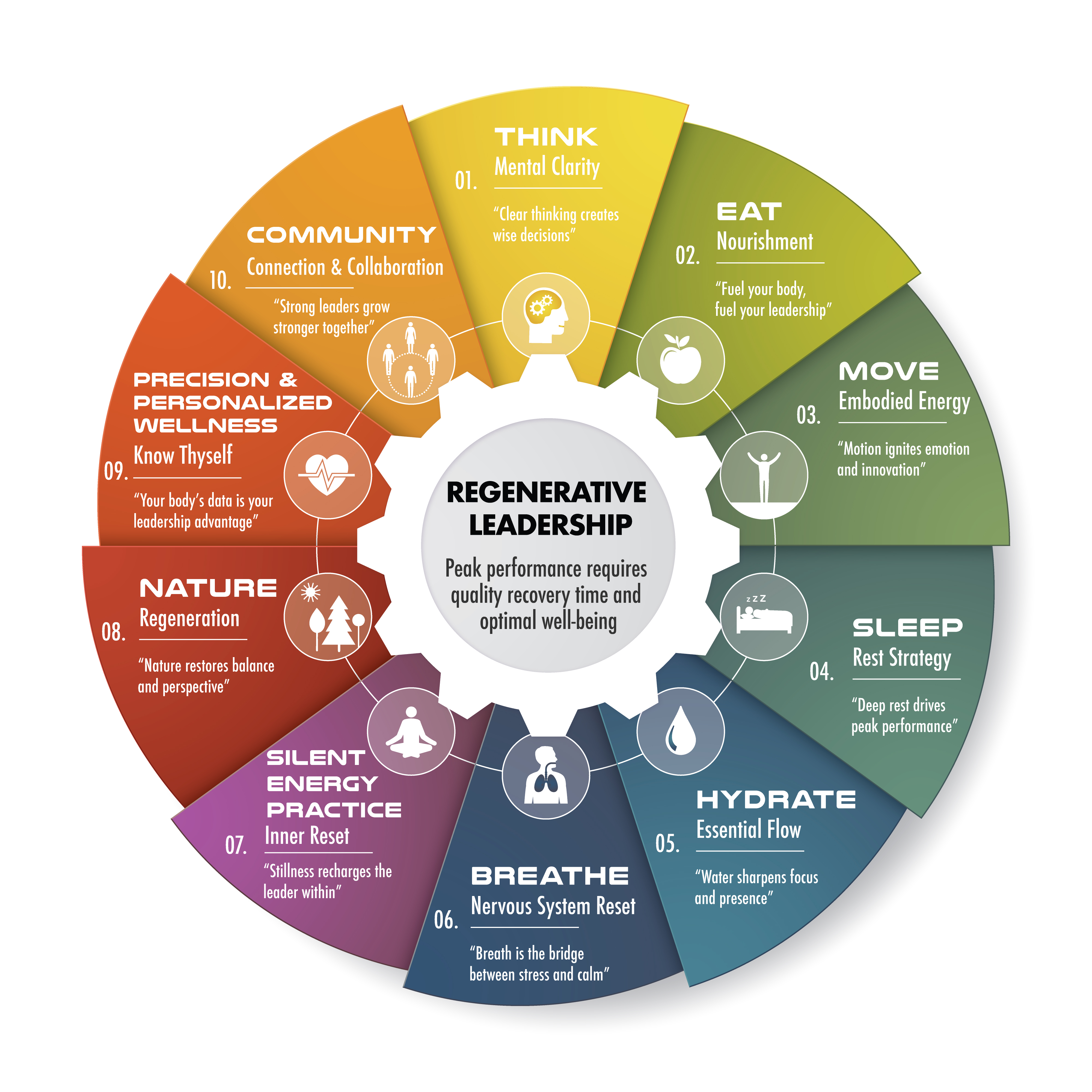
The model I am developing is built around ten interconnected elements that mirror the miracles of nature and the foundations of human wellbeing:
1. Think – Mental Clarity:
Clear thinking creates wise decisions. Regenerative leaders cultivate focus through mindfulness, reflection, and time in nature. Neuroscience confirms that spending just 20 minutes in natural settings can significantly reduce cortisol and restore cognitive function.
2. Eat – Nourishment:
Fuel your body, fuel your leadership. Food is information. Nutritional psychiatry research shows that whole, unprocessed foods rich in omega-3s and antioxidants enhance mood, concentration, and resilience. Corporate leaders need to fuel their leadership as much as their laptops.
3. Move – Embodied Energy:
Movement ignites emotion and innovation. Regular physical activity not only boosts cardiovascular health but also strengthens neuroplasticity and creativity. The University of Illinois found that walking outdoors improves divergent thinking by 60%. a key driver of problem-solving.
4. Sleep – Rest Strategy:
Deep rest drives peak performance. Sleep is the most underutilized productivity tool available. Studies from the Sleep Foundation show that consistent, high-quality sleep enhances emotional regulation, memory, and leadership presence.
5. Hydrate -Essential Flow:
Water sharpens focus and presence. No water, now life. Often when we feel hungry, we are actually thirsty. Even a 2% drop in hydration can impair cognitive performance, mood, and decision-making.
Studies from the University of Connecticut show that mild dehydration leads to increased fatigue, tension, and anxiety all of which impact leadership clarity and emotional regulation. Hydrate before you caffeinate.
Begin your day with 500ml of water before coffee or tea to rehydrate after overnight fluid loss. This simple ritual supports brain function, alertness, and emotional balance the foundation for clear, conscious leadership.
6. Breathe – Nervous System Reset:
Breath is the bridge between stress and calm. Techniques such as box breathing and coherent breathing regulate the vagus nerve, activating the body’s relaxation response and restoring balance to the nervous system.
7. Silent Energy Practices – Inner Reset:
Stillness recharges the leader within. Practices such as meditation, journaling, or time in silence enhance self-awareness, intuition, and empathy the cornerstone of emotionally intelligent leadership.
8. Nature – Regeneration:
Nature restores balance and perspective. The Japanese practice of Shinrin-Yoku or “forest bathing” has been scientifically shown to lower blood pressure, boost immune function, and enhance mood. Nature-based leadership immersions help leaders “rewild” their minds and reconnect with what truly matters.
9. Personalized & Precision Health:
`Know thy self. Your body’s data is your leadership advantage. Wearable technology and functional testing now allow leaders to track biomarkers of stress, inflammation, and recovery, bringing science to self-awareness. I personally choose to have DNA Analysis and Blood Biomarker testing to fine tune my exercise, nutrition and supplements at Elite Vita Wellness & Longevity Clinic in Dubai Healthcare City.
10. Community – Connection & Collaboration:
Strong leaders grow stronger together. Regenerative cultures foster belonging, psychological safety, and trust. Teams that connect authentically are proven to be 2.5 times more innovative, according to Gallup (2024).
Purpose
While not listed as an element, purpose underpins all others. Leaders who align daily actions with a meaningful purpose exhibit greater vitality and resilience under pressure. Having a strong purpose makes it easier to make day to day decisions , ones that take the team and the business toward the identified purpose.
Implementing Regeneration in the Workplace
Transforming burnout into balance starts with small, consistent shifts. Here’s a few ideas for organizations to begin embedding regenerative principles into their culture:
1. Model Recovery at the Top:
When senior leaders prioritize wellbeing and model healthy rhythms, it gives permission for others to follow. Leadership behaviours shape culture faster than any policy.
2. Design Rhythmic Workflows:
Replace “back-to-back” with “breathe-between.” Encourage 50-minute work cycles followed by 10-minute micro-breaks to restore focus and energy.
3. Create Regenerative Spaces:
Incorporate biophilic design, natural light, plants, and access to outdoor areas. Offices that mimic natural environments see up to 15% higher productivity and 6% fewer sick days.
4. Integrate Personalized Wellness Programs:
Move beyond generic health initiatives to offer data-driven solutions sleep tracking, HRV monitoring, nutrition guidance based on individual needs.
5. Facilitate Nature-Based Learning:
Take leadership development out of the boardroom and into the wild. Nature-Based Leadership programmes and retreats invite teams to explore resilience and adaptability through the wisdom of nature itself.
6. Measure What Matters:
Track energy, engagement, and vitality as seriously as revenue and ROI. What gets measured, grows.
The Regenerative Advantage
When leaders are rested, nourished, and connected, they make better decisions, inspire more trust, and lead with authenticity. Teams thrive under leaders who operate from a state of vitality rather than depletion.
It’s no coincidence that the world’s most sustainable eco -systems, coral reefs, forests, and rivers, are also the most collaborative. Regenerative leaders, like these ecosystems, understand that the future of business depends on reciprocity, renewal, and rhythm.
Pioneering Regenerative Leadership in the Middle East and Beyond
As someone who has lived and worked in the Middle East for over 20 years, I’ve witnessed an incredible transformation in how organizations approach leadership and wellbeing. Today, the region is ready for a new wave; one that integrates science, nature, and human potential into leadership design.
Through my work with global organizations, business schools, and forward-thinking leaders, I’ve seen firsthand the power of regeneration to spark innovation, deepen engagement, and sustain performance.
If you’re ready to future-proof your leadership team and cultivate a regenerative culture, let’s start a conversation. Whether through keynotes, immersive offsites, or executive retreats, I love helping leaders and organizations restore rhythm, resilience, and renewal, so thriving becomes SECOND NATURE.
By Julie Lewis, Explorer, Speaker, and Regenerative Leadership Strategist
Website: www.julie-lewis.com
Email: info@julie-lewis.com
Related Posts

The Ultimate C-Suite Learning & Development Blueprint
In the realm of corporate leadership, the role of wholesome communication in the C-Suite can...

Minister of Human Resources and Emiratisation meets Iranian Ambassador to UAE
His Excellency Dr. Abdulrahman Al Awar, Minister of Human Resources and Emiratisation, met with His ...

The International Coaching Federation Announces Inaugural Converge Summit 2026
Registration is now open. For more information visit: icfconvergesummit.com The Internationa...

Extraordinary Mistakes for the Year Ahead
As we begin to look ahead to 2023, it might seem a little odd that my first blog is about making mis...

Dr. Abdulrahman Al Awar Comments on UAE President’s Address to the Nation
The historic address of His Highness Sheikh Mohammed bin Zayed Al Nahyan, President of the UAE, to t...

Manipal Academy Committed to Addressing Market Trends In The Workplace
Manipal Academy of Higher Education (MAHE) Dubai proudly announces the launch of its groundbreaking ...

Planning is Overrated
Planning IS important – no doubt about it. As the famous adage goes: Failing to plan is like p...

The Wonder of Living in a World of Infinite Possibilities
I love this model by Gihan Perera. There are so many things when you think about it that were once ...

Eleven Percent of GDP lost to Employee Disengagement
Start here: The Business Case for Emotional Intelligence What’s the most expensive thing in...

The Nine Essential Pursuits Of Wise Leaders
I’ve had the great honour and privilege since 1990 to be in the room with more than a million ...
