
The Window of Tolerance:
Why Nervous System Regulation Is Becoming a Leadership Essential in the Gulf
OPINION PIECE
Julie Lewis, Author, Adventurer, Public speaker, UAE
5/12/20262 min read


In today’s high-pressure business environment across the Gulf region, many organisations are investing heavily in leadership development, AI, strategy, and productivity tools. Yet one of the biggest influences on performance often goes unnoticed: the human nervous system.
From the fast pace of growth in the UAE and Saudi Arabia to increasing digital overload, economic uncertainty, and rising workplace stress, leaders are being asked to operate under constant pressure. The challenge is that when pressure rises, performance does not simply “break down” — the nervous system does.
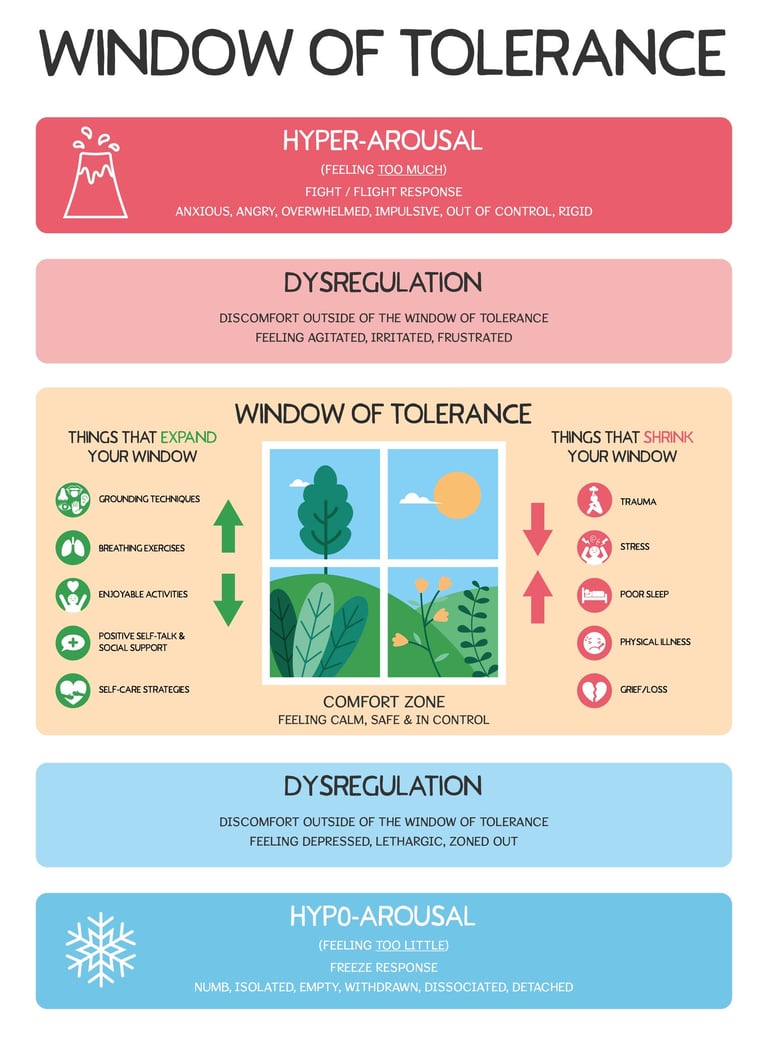
One of the most important neuroscience concepts leaders can understand is the Window of Tolerance, developed by psychiatrist Dr. Daniel Siegel. The Window of Tolerance describes the optimal zone where we feel calm, focused, emotionally regulated, and able to think clearly. Inside this window, people communicate effectively, collaborate well, make better decisions, and respond to challenges with resilience rather than reactivity.
Outside the window, the brain shifts into survival mode.
Above the window — known as hyper-arousal — people may become anxious, reactive, overwhelmed, impatient, or controlling.
Below the window — hypo-arousal — they may withdraw, disengage, shut down emotionally, or struggle to focus.
This matters deeply for organisations across the Gulf, where workplace stress and burnout are rising concerns. Studies across the UAE have shown high levels of employee stress, digital fatigue, and emotional exhaustion, particularly in fast-moving sectors such as finance, hospitality, energy, healthcare, and technology. In cultures where high performance and constant availability are often valued, many employees silently operate outside their optimal state for prolonged periods.
The result?
Reduced focus. Poorer decision-making. Reactive communication. Lower creativity. Increased conflict. Emotional exhaustion.
Leaders often interpret these behaviours as attitude or motivation issues when, in reality, they are frequently signs of nervous system dysregulation.
This is why nervous system awareness is becoming a critical leadership skill.
A regulated leader creates psychological safety, clarity, trust, and steadiness during uncertainty. Teams do not only respond to a leader’s words, they respond to their state.
The encouraging news is that the Window of Tolerance can be expanded.
Simple evidence-based practices such as conscious breathing, quality sleep, movement, social connection, mindfulness, and time in nature all help regulate the nervous system and increase resilience capacity. Even brief exposure to blue and green spaces — the ocean, mangroves, parks, desert landscapes, or mountain environments — has been shown to lower stress hormones and improve cognitive recovery.
For leaders in the Gulf, this presents a powerful opportunity: to move beyond burnout culture and create workplaces where sustainable performance becomes possible.
Nature offers an important reminder.
A mountain does not resist the storm.
Water does not fight the rock.
A forest does not rush its growth.
They adapt. They regulate. They endure.
ME HR & Learning is THE leading online news and information platform for HR and L&D professionals in the Middle East.


© Copyright 2026 ME HR & Learning
The Platform
Learning & Resources
Professional Network
Location
Sharjah Media City, SHAMS, UAE