
Climbing the Ladder: Why Your Nervous System Matters More Than Your Strategy
OPINION PIECE
Julie Lewis
4/19/20262 min read

Why this matters for leaders in the GCC
Across the region, the data is clear. According to the latest Cigna Healthcare Vitality Study, 89% of people in the UAE report experiencing stress, and 99% report at least one symptom of burnout. In fast-growing economies where leaders are navigating constant change, this has direct implications for performance.
When teams operate from:
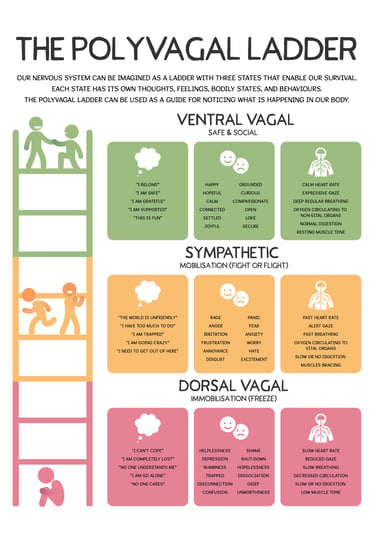
Ventral (safe & connected) → higher creativity, collaboration, and cognitive clarity
Sympathetic (stress response) → urgency, reactivity, short-term thinking
Dorsal (shutdown) → disengagement, low energy, reduced productivity
The state of your team is not separate from business results, it drives them.
Research in neuroscience and organizational psychology consistently shows that regulated nervous systems enhance decision-making, emotional intelligence, and team cohesion. Simply put: calm brains think better, and regulated teams perform better.
Practical ways to regulate and lead effectively
Leaders don’t need complex interventions to shift state, small, consistent practices can have measurable impact:
1. Breathe to lead
Extend your exhale (e.g. inhale for 4, exhale for 6). This activates the parasympathetic nervous system and signals safety.
2. Use your environment
Step outside, even briefly. Exposure to natural elements has been shown through Attention Restoration Theory to reduce cognitive fatigue and stress.
3. Connect before you correct
A simple, genuine check-in—“How are you, really?”—can shift someone from stress to safety. Social connection is a biological regulator.
4. Name to tame
Labeling emotions reduces amygdala activation and brings the brain back online for clearer thinking.
The most effective leaders today are not just managing performance metrics.
They are managing state, their own, and that of their teams.
In a world of constant change, regulation is no longer a wellness tool.
It is a leadership advantage.
Julie Lewis is an international keynote speaker, explorer, and author specializing in nature-based leadership, resilience, and nervous system regulation. With over 25 years leading teams in extreme environments, she helps leaders across the GCC build adaptive resilience, sustain energy, and perform under pressure. Julie is the author of Uncharted Waters and works with organizations to enhance clarity, wellbeing, and high-performance leadership.
In today’s high-pressure business environment across the UAE and wider GCC, performance is often framed as a mindset challenge. Leaders are encouraged to think differently, act decisively, and push through uncertainty.
But neuroscience tells us a different story.
Performance doesn’t start with mindset.
It starts with the nervous system.
The concept of the Polyvagal Ladder, developed by Stephen Porges, explains how we move through three core physiological states each day:
Ventral Vagal (top): calm, connected, clear thinking
Sympathetic (middle): stressed, reactive, fight-or-flight
Dorsal Vagal (bottom): shut down, disengaged, overwhelmed
We don’t think our way into these states; we feel our way into them and from each state, our ability to lead, communicate, and make decisions shifts dramatically.
ME HR & Learning is THE leading online news and information platform for HR and L&D professionals in the Middle East.


© Copyright 2026 ME HR & Learning
The Platform
Learning & Resources
Professional Network
Location
Sharjah Media City, SHAMS, UAE